
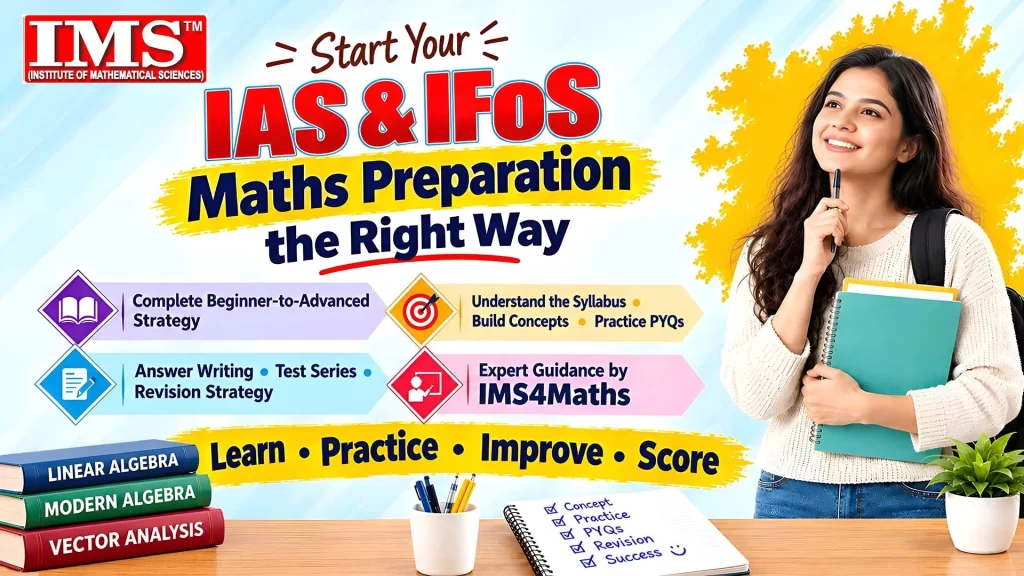
Choosing Mathematics as your optional subject for the UPSC Civil Services Examination can be a strong option for aspirants who enjoy mathematics and are comfortable with logical problem-solving.
However, many students have the same question:
How do you start Maths Optional for UPSC?
The answer is not simply to collect books and start solving difficult problems. A successful UPSC Maths Optional preparation strategy requires a structured approach that combines syllabus coverage, conceptual understanding, previous-year questions, answer writing, revision and regular testing.
This guide explains how to start Maths Optional for UPSC, how beginners can create a study plan, and how IAS and IFoS aspirants can improve their preparation.
How to Start Maths Optional for UPSC?
If you are beginning your Mathematics Optional preparation, avoid trying to cover the entire syllabus immediately.
Start with these five steps:
- Understand the UPSC Mathematics Optional
- Divide the syllabus into manageable
- Build strong mathematical
- Start solving previous-year
- Begin answer-writing practice
Your preparation should gradually move from concepts → practice → PYQs → answer writing → tests
→ revision.
This approach can make your preparation more systematic and measurable. UPSC Maths Optional Preparation for Beginners
For beginners, the biggest challenge is usually deciding what to study first. A simple preparation framework is:
Stage 1: Understand the Syllabus
Before selecting books or starting intensive practice, carefully go through the Mathematics Optional syllabus.
Create a topic checklist and divide it into:
- Topics you already understand
- Topics requiring conceptual study
- Topics requiring extensive practice
- Topics requiring revision This prevents random
Stage 2: Strengthen Your Concepts
Mathematics Optional requires more than memorising formulas.
You should understand:
- Definitions
- Theorems
- Formulae
- Standard methods
- Problem-solving approaches
- Applications
A strong conceptual foundation makes it easier to solve unfamiliar questions.
Stage 3: Practise Problems Regularly
Mathematics improves through practice.
Instead of solving hundreds of questions without analysis, focus on understanding different approaches to a problem.
After solving a question, ask:
Could I solve this faster? Is there another method?
Did I make any calculation error?
Would my solution be clear to an examiner?
This type of analysis can improve both accuracy and speed. UPSC Maths Optional Study Plan
A study plan should be realistic and flexible.
You can divide your preparation into four major cycles:
Cycle 1 — Concept Building
Complete the basic concepts of each topic.
Cycle 2 — Problem Solving
Solve standard and UPSC-level problems.
Cycle 3 — Previous-Year Questions
Practise UPSC Maths Optional previous-year questions topic-wise.
Cycle 4 — Tests and Revision
Take timed tests, analyse mistakes and revise weak areas.
The important point is to repeat these cycles rather than treating them as completely separate stages. UPSC Maths Optional PYQ Analysis
UPSC Maths Optional PYQ analysis should be an important part of your preparation.
Previous-year questions help you understand the type of questions asked and identify topics that require greater attention.
While analysing PYQs, maintain a simple record:
Topic Question Practised Difficulty Mistake Revision Needed Topic A Yes Moderate Calculation Yes
Topic B Yes | Difficult | Concept | Yes |
Topic C Yes | Easy | None | No |
Over time, this becomes your personal revision database.
Do not wait until the end of preparation to look at PYQs. Use them throughout your preparation. UPSC Maths Optional Answer Writing
Many students focus only on solving questions but don’t practise writing complete answers. UPSC Maths Optional answer writing deserves regular attention.
A good mathematical answer should be:
- Structured
- Logical
- Legible
- Step-by-step
- Relevant
- Time-efficient
Show the important reasoning behind your solution instead of presenting unexplained calculations. Regular answer-writing practice can also help you identify where you are losing time.
How to Improve Maths Optional Answer Writing
Start by practising individual questions. Then gradually move towards:
Question → 10-minute solution → timed sectional test → full-length paper After every test, analyse your presentation.
Check:
- Did you understand the question correctly?
- Did you use the appropriate formula or theorem?
- Were your steps logically arranged?
- Did you make calculation errors?
- Did you reach the final answer?
- Did you spend too much time on one question?
This process is more valuable than simply counting the number of questions attempted. Maths Optional Preparation in 6 Months
Students searching for Maths Optional preparation in 6 months should focus on prioritisation rather than trying to study everything repeatedly.
A possible six-month structure is:
Month 1–2: Foundation
Focus on concepts and important syllabus areas.
Month 3–4: Intensive Practice
Increase problem-solving and start systematic PYQ practice.
Month 5: Answer Writing and Tests
Begin regular timed tests and improve presentation.
Month 6: Revision
Focus on:
- Important concepts
- Formula revision
- PYQs
- Mistake notebook
- Mock tests
- Weak areas
The exact schedule should be adjusted according to your mathematics background and available study time.
How to Revise Maths Optional for UPSC
Revision should not mean reading the same material repeatedly. Create short revision resources such as:
- Formula sheets
- Important theorems
- Frequently used methods
- Difficult questions
- Previous mistakes
- Important PYQs
During revision, spend more time on areas where you repeatedly make mistakes.
UPSC Maths Optional Paper 1 Strategy
Paper 1 preparation should be approached topic by topic.
For each topic:
Learn the concept → solve examples → practise PYQs → write timed answers → revise
Don’t move forward simply because you have completed a chapter. Make sure you can solve representative questions independently.
UPSC Maths Optional Paper 2 Strategy
Paper 2 should receive the same structured treatment.
Create a topic-wise tracker and monitor:
- Concept completion
- Problem practice
- PYQs
- Test performance
- Revision status
Regular testing can help reveal which areas require additional practice.
IFoS Maths Optional Preparation
Mathematics can also be relevant for aspirants preparing for the Indian Forest Service Examination (IFoS).
An IFoS Maths Optional preparation strategy should similarly focus on understanding the syllabus, practising relevant questions, improving speed and accuracy, and completing timed tests.
If you are preparing for both IAS and IFoS, organise your preparation carefully so that common mathematical preparation is used efficiently.
Common Maths Optional Mistakes to Avoid
- Starting Without Understanding the Syllabus
Know what you need to study before deciding how to study it.
2. Collecting Too Many Resources
More books do not automatically mean better preparation. Choose reliable resources and revise them properly.
3. Ignoring PYQs
Previous-year questions should be part of your preparation from an early stage.
4. Delaying Answer Writing
Start practising written solutions before the final phase.
5. Not Taking Tests
Testing reveals problems with speed, accuracy, presentation and topic coverage.
6. Not Analysing Mistakes
A test becomes much more useful when you analyse why you lost marks or time. Is Maths Optional Suitable for You?
Mathematics Optional may suit aspirants who:
- Enjoy mathematical problem solving
- Have reasonable mathematical fundamentals
- Are willing to practise consistently
- Prefer a more structured and analytical subject
- Are comfortable working through numerical problems
Your academic background is one factor, but genuine interest and sustained practice are also important.
Why Choose Structured Maths Optional Guidance?
Self-study can work for some aspirants, but structured guidance can help with:
- Syllabus planning
- Concept clarification
- Problem-solving methods
- Answer writing
- Regular testing
- Performance analysis
- Revision
IMS4Maths provides Mathematics Optional preparation programmes aimed at UPSC IAS and IFoS aspirants, along with study resources and test-based preparation.
Frequently Asked Questions
Is Maths Optional difficult for UPSC beginners?
Mathematics Optional can be challenging, particularly if your fundamentals are weak. However, a structured approach involving concepts, practice, PYQs, answer writing, and revision can make preparation more manageable.
How should I start Maths Optional for UPSC?
Start by understanding the syllabus, assessing your mathematical fundamentals, selecting appropriate study resources, and beginning topic-wise problem practice.
Is Maths Optional good for IAS?
Mathematics can be considered by aspirants who are comfortable with mathematical problem-solving and are prepared to practise consistently.
How important are PYQs for Maths Optional?
PYQs are highly useful for understanding the examination pattern, identifying important concepts and practising the type of problems you may encounter.
How can I improve Maths Optional answer writing?
Practise writing complete solutions under time limits. Focus on logical steps, clear presentation, correct calculations, and completing answers within the available time.
Can I prepare Maths Optional in 6 months?
A six-month preparation plan is possible for some aspirants, but the required time depends on your existing mathematical foundation, syllabus familiarity, and daily study time.
Final UPSC Maths Optional Strategy
A strong Mathematics Optional preparation strategy does not depend on studying endlessly. It depends on studying systematically and consistently.
Remember this cycle:
Understand → Practise → Solve PYQs → Write Answers → Take Tests → Analyse → Revise
If you are starting your UPSC Maths Optional preparation, focus first on building your foundation. Gradually increase problem-solving practice, introduce answer writing, analyse PYQs, and use tests to identify your weaknesses.
For IAS and IFoS aspirants, a structured and consistent approach can make Mathematics Optional preparation much more organised.
Prepare for UPSC Mathematics Optional with IMS4Maths
IMS4Maths provides Mathematics Optional preparation resources and programmes for UPSC IAS and IFoS aspirants.
Explore the available courses, programmes and test-series options through the IMS4Maths website.
