
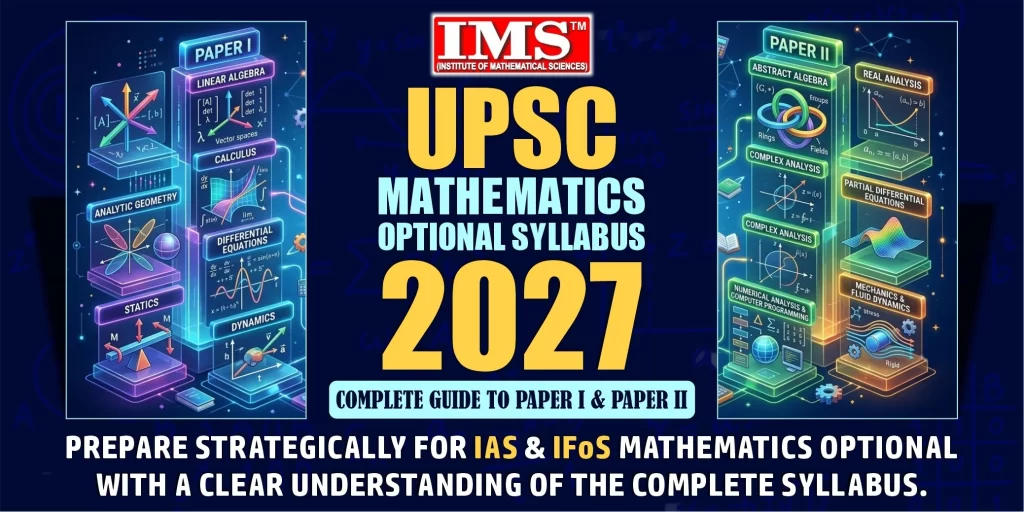
UPSC MATHEMATICS OPTIONAL SYLLABUS 2027
Complete Paper I & Paper II Guide for IAS and IFoS Aspirants
Introduction
Preparing for the UPSC Civil Services Examination with Mathematics as your optional subject? Understanding the syllabus is the first step towards a focused preparation plan. Mathematics Optional requires conceptual clarity, logical reasoning, consistent problem-solving practice, revision and time management. This guide summarises the major Paper I and Paper II areas and offers a practical preparation framework for IAS and IFoS aspirants.
IMS4Maths – Institute of Mathematical Sciences provides information about Mathematics Optional courses, study material, test series, sample solutions and previous-year question papers. Aspirants can use these resources alongside the official examination notification.
UPSC Mathematics Optional Exam Overview
The Civil Services Main Examination Mathematics Optional normally comprises two papers of 250 marks each, totalling 500 marks. Always confirm the applicable structure and instructions in the latest UPSC notification.
Detail | Summary |
Optional subject | Mathematics |
Paper I | 250 marks |
Paper II | 250 marks |
Total | 500 marks |
Preparation priorities | Theory, derivations, numerical problems, previous-year questions and answer presentation |
Paper I: Main Syllabus Areas
1. Linear Algebra
Vector spaces over R and C; linear dependence and independence; subspaces, bases and dimension; linear transformations; rank and nullity; matrices and their algebra; row and column reduction; rank and inverse of a matrix; systems of linear equations; eigenvalues and eigenvectors; characteristic polynomial; Cayley–Hamilton theorem; and relevant matrix types and properties.
2. Calculus
Real numbers and real-valued functions; limits, continuity and differentiability; mean-value theorem; Taylor’s theorem with remainders; indeterminate forms; maxima and minima; asymptotes and curve tracing; functions of two or three variables; partial derivatives; Lagrange multipliers; Jacobians; definite and indefinite integrals; improper integrals; multiple integrals; and applications involving areas, surfaces and volumes.
3. Analytic Geometry
Coordinate geometry in two and three dimensions, straight lines and planes, and the standard geometric surfaces and conicoids covered in the official syllabus. Check the detailed IMS4Maths syllabus page for the complete topic list.
4. Ordinary Differential Equations
First-order and higher-order differential equations, linear equations, standard solution methods, systems and series solutions as specified in the official syllabus.
5. Dynamics and Statics
Motion, forces, equilibrium and related mechanics problems. Practise the prescribed topics using clear diagrams and stepwise calculations.
6. Vector Analysis
Scalar and vector fields; vector differentiation; gradient, divergence and curl; line, surface and volume integrals; and the integral theorems and applications specified in the syllabus.
Paper II: Main Syllabus Areas
1. Algebra
Groups and related algebraic structures, including subgroups, cyclic groups, normal subgroups, quotient groups, homomorphisms, rings, ideals, integral domains and fields as prescribed by the official syllabus.
2. Real Analysis
Sequences and series, limits, continuity, differentiability, integration, convergence and other real-analysis concepts specified in the official syllabus.
3. Complex Analysis
Analytic functions, Cauchy–Riemann equations, complex integration, Cauchy’s theorems and integral formula, Taylor and Laurent series, singularities and residues, and related applications.
4. Linear Programming
Formulation of optimisation problems, graphical and simplex methods, duality, and other prescribed linear-programming applications.
5. Partial Differential Equations
Formation and solution of first-order and higher-order PDEs, standard methods, classification and applications as specified in the official syllabus.
6. Numerical Analysis and Computer Programming
Numerical methods for equations, interpolation, numerical differentiation and integration, numerical solutions of differential equations, and the programming topics included in the syllabus.
7. Mechanics and Fluid Dynamics
Mechanics of rigid bodies and prescribed fluid-dynamics concepts, equations and applications.
Syllabus accuracy note: This article is an SEO-friendly overview, not a verbatim reproduction of the complete official syllabus. IMS4Maths has detailed syllabus pages for Mathematics and IFoS. Verify every subtopic against the relevant latest official UPSC notification before publishing this as a definitive syllabus.
How to Prepare for Mathematics Optional
Study the syllabus first
Divide the syllabus into units and track learning, revision and question practice separately.
Build conceptual understanding
Learn definitions, standard results and theorem conditions before memorising solution patterns.
Use previous-year questions
Solve questions topic-wise, then attempt full papers under timed conditions. IMS4Maths provides IAS and IFoS question-paper resources.
Maintain revision notes
Record formulas, theorem statements, standard derivations, common mistakes and useful methods.
Practise answer presentation
Show logical steps, state the relevant result, justify calculations and make the final result easy to identify.
Take mock tests
Review each test for accuracy, speed, incomplete solutions and weak topics.
Revise in cycles
Return regularly to difficult topics and reattempt questions that were previously answered incorrectly.
Is Mathematics Optional Right for You?
Mathematics Optional may suit candidates who enjoy mathematical reasoning and can commit to sustained problem-solving practice. The syllabus is organised around defined mathematical topics, and practice can help improve speed and accuracy. However, advanced concepts require time and consistent effort; the subject is not automatically easy or high-scoring for everyone. Review the syllabus and try previous-year questions before making your choice.
Common Preparation Mistakes
- Starting without reading the full official
- Memorising formulas without understanding their conditions or
- Ignoring proof-based questions and
- Delaying previous-year question
- Leaving revision until the final
- Not analysing mock-test
- Relying on an outdated or incomplete syllabus
Frequently Asked Questions
How many papers are there in UPSC Mathematics Optional?
The standard Civil Services Main Examination structure includes two Mathematics Optional papers, each carrying 250 marks. Confirm the latest notification.
What are the main Paper I topics?
Linear Algebra, Calculus, Analytic Geometry, Ordinary Differential Equations, Dynamics and Statics, and Vector Analysis.
What are the main Paper II topics?
Algebra, Real Analysis, Complex Analysis, Linear Programming, Partial Differential Equations, Numerical Analysis and Computer Programming, and Mechanics and Fluid Dynamics.
Where can I find Mathematics Optional previous-year papers?
Use the UPSC previous-question-paper portal and the IAS/IFoS question-paper resources linked from IMS4Maths.
Where can I find the detailed syllabus on IMS4Maths?
Visit the IMS4Maths Mathematics Syllabus page and the separate IAS/IFoS Mains Mathematics Optional Syllabus page linked below.
References from IMS4Maths Website
The following IMS4Maths pages were used to align the blog with the institute’s published syllabus, course information and preparation resources. Confirm that the pages and course details remain current before publication.
· IMS4Maths Home – overview of the institute, courses and learning support
· Mathematics Syllabus – Paper I and topic-wise syllabus information
https://ims4maths.com/mathematics-syllabus/
· IAS/IFoS Mains Mathematics Optional Syllabus – detailed syllabus synopsis for both papers
https://ims4maths.com/ias-ifos-mains-mathematics-optional-syllabus/
· IAS Mathematics Optional – course information, sample study material and previous-year papers
· General Information About Courses – classroom, weekend, test-series and correspondence programmes
https://ims4maths.com/our-courses/
· Courses – course formats and contact details
https://ims4maths.com/courses/
· Mathematics Optional Quick Learning Programme
https://ims4maths.com/quick-learning-programme/
· Correspondence Study Material – Mathematics Optional study-material information
https://ims4maths.com/order-online-ias-ifos-mathematics-postal-correspondence-study-material/
· UPSC previous question papers – official UPSC resource
https://www.upsc.gov.in/examinations/previous-question-papers
